Extendable Lowbed Semi Trailer – Long & Oversized Cargo Transport
Alura Trailer manufactures extendable lowbed semi trailers for long and oversized cargo, featuring telescopic deck extension, reinforced high-strength chassis, low loading height and configurable axle and steering systems.

Extendable Lowbed Trailer for Long & Oversized Cargo Transport
Alura Trailer manufactures Extendable Lowbed Semi Trailers engineered for the transportation of long, oversized and abnormal cargo such as wind turbine components, steel structures, bridge components, pipes, beams and industrial modules that exceed standard trailer length limits.
Constructed using ST52 and Strenx 700MC high-strength structural steel options, these extendable lowbed trailers are developed to manage bending and torsional forces associated with extended deck lengths and demanding road conditions.
Featuring a hydraulically assisted telescopic extension system, low deck height, reinforced gooseneck structure and flexible axle configurations, this trailer is suitable for consideration in heavy haulage, infrastructure, industrial logistics and specialized oversized transport projects.
The main engineering advantage of an extendable lowbed semi trailer is the ability to adapt the effective loading length to suitable cargo dimensions while retaining the ability to return the trailer to a shorter transport configuration.
Extendable Lowbed Trailer at a Glance
These are indicative configuration ranges, not dimensions of a single fixed model. The final extension stroke and overall dimensions must be established in the approved manufacturing drawing.
Key Features & Advantages
- High-Strength Main Chassis: ST52 / Strenx 700MC reinforced I-beam construction with robotic welding options
- Extendable System: Hydraulically assisted telescopic extension for long and abnormal cargo
- Axle Configurations: Multiple axle layouts according to design requirements
- Suspension: Mechanical leaf spring or air suspension
- Gooseneck: Reinforced heavy-duty structure for extended deck applications
- Braking System: WABCO or Knorr-Bremse EBS / ABS with RSS options where applicable
- Side Extensions: Detachable side brackets for additional platform width
- Flooring: Hardwood, chequered plate or wear-resistant steel flooring
- Tie-Down Points: Heavy-duty lashing rings and stake pockets
- Electrical System: 24V LED lighting with appropriate sockets
This extendable lowbed configuration is developed for long, oversized and abnormal load transport where loading length, stability and route-specific requirements are central to the transport plan.
Extendable Lowbed Semi Trailer Technical Specifications
| Component | Technical Specification |
|---|---|
| Main Chassis | ST52 / Strenx 700MC high-strength structural steel options, reinforced welded I-beam construction |
| Platform Height | Approximately 850–950 mm, depending on project configuration |
| Base Length | Approximately 13,500–15,000 mm |
| Extended Length | Approximately 18,000–22,000 mm, depending on selected design |
| Extension Mechanism | Telescopic sliding chassis with hydraulic assistance and locking positions |
| Axle Configurations | Multiple axle arrangements, subject to payload, geometry and regulatory requirements |
| Suspension | Mechanical leaf springs or air suspension |
| Lifting Axles | Optional, subject to engineering approval |
| Gooseneck | Reinforced heavy-duty gooseneck |
| Steering | Fixed, self-tracking rear or hydraulically steered axles |
| Tyres | 235/75 R17.5, 245/70 R17.5 or 275/70 R22.5 options |
| Braking | WABCO or Knorr-Bremse EBS / ABS; 4S/2M, 4S/3M or 6S/3M according to configuration |
| Lighting | 24V LED lighting with appropriate electrical connections |
| Flooring | Hardwood and/or 4–6 mm chequered steel plate in selected areas |
| Paint | Grit blasting, epoxy primer and protective acrylic topcoat |
| Standard Equipment | Tool box, fire extinguisher cabinet, spare wheel carrier, wheel chocks, reflectors and rear protection |
| Optional Equipment | Detachable gooseneck, hydraulic steering, side extensions, extension rollers, custom locks, tool boxes, special colours and company logos |
All specifications can be customized according to country regulations, abnormal load permits, cargo length requirements and fleet operating needs, subject to engineering feasibility.
How Does an Extendable Lowbed Trailer Work?
An extendable lowbed trailer uses a telescopic chassis arrangement in which selected structural sections slide relative to one another. The sliding system provides additional effective loading length for cargo that cannot be accommodated on a conventional fixed-length trailer.
The listed Alura Trailer configuration uses a hydraulically assisted extension mechanism and defined locking positions. The final design must include appropriate structural guides, support surfaces and a locking system for the intended operating conditions.
1. Release
The extension locking arrangement is released according to the approved operating procedure.
2. Extend
The telescopic chassis is moved to the required approved extension position.
3. Lock
The extension is secured using the specified mechanical locking arrangement before transport.
Closed vs Extended Lowbed Trailer — Telescopic Length Diagram
The following schematic illustrates how a telescopic lowbed can increase its effective loading length. It is a conceptual visualization rather than a production drawing.
Conceptual illustration only. Trailer proportions, axle positions, extension travel and load-bearing details are not to scale.
Extendable Lowbed Length Comparison
The published configuration ranges include approximate base lengths of 13.5–15 metres and extended lengths of 18–22 metres.
The chart below compares illustrative length endpoints. The values are not a claim that every listed base length can extend to every listed maximum length.
Indicative Length Range
Chart scale: 22 metres = 100%. Indicative configuration values only.
Calculate Extension Length and Percentage
Use this preliminary calculator to compare a proposed base length with a proposed extended length. The tool calculates geometry only; it does not determine structural capacity or transport approval.
Why Trailer Extension Changes Structural Loading
Increasing the effective loading length changes the geometry of the chassis and can affect the bending moments and deflections generated by cargo.
The structural effects depend on cargo mass, support positions, center of gravity, chassis stiffness, extension overlap and the reactions at the kingpin and axle group.
Longitudinal Bending
Extended configurations require assessment of bending moments along the chassis and telescopic sections.
Extension Overlap
The sliding structure must retain sufficient engagement and support for the approved operating condition.
Local Support Loads
Cargo contact points can generate concentrated loads that require local structural reinforcement.
Torsional Loading
Uneven roads, asymmetric cargo and maneuvering can create torsional loading in the chassis.
Kingpin Load, Axle Reactions and Cargo Position
The total supported trailer mass is transferred through the kingpin and fifth-wheel connection and the trailer axle group.
Extending the trailer changes the relative positions of structural elements and potentially the cargo support points. For this reason, load distribution must be calculated for the selected operating configuration.
A longer trailer does not automatically provide a higher payload. The permissible load remains subject to chassis design, axle-group limits, kingpin capacity, tractor compatibility and legal transport requirements.
Fixed Lowbed vs Extendable Lowbed Semi Trailer
| Feature | Fixed Lowbed | Extendable Lowbed |
|---|---|---|
| Loading Length | Fixed | Variable within approved positions |
| Chassis Design | Fixed structural arrangement | Telescopic sliding structure |
| Long Cargo | Limited by fixed platform geometry | Additional length options |
| Maintenance | Conventional trailer systems | Additional extension guides, locks and hydraulic components |
| Tare Weight | Design-dependent | May increase due to telescopic components |
| Engineering Assessment | Approved fixed configuration | Approved operating positions and loading cases |
| Typical Applications | Construction machinery and industrial equipment | Long machinery, steel structures and project cargo |
What Cargo Can an Extendable Lowbed Transport?
Wind Energy Components
Selected wind turbine components and related industrial equipment, subject to cargo geometry and suitable transport supports.
Long Steel Structures
Fabricated beams, structural assemblies and other elongated industrial steel components.
Bridge Components
Precast and fabricated bridge elements requiring additional effective transport length.
Pipes and Industrial Modules
Long pipes, industrial assemblies, process equipment and selected oversized project cargo.
Hydraulic Telescopic Extension and Locking System
A hydraulically assisted extension system can simplify movement of the telescopic structure between approved operating positions.
The extension system must be designed with suitable structural guides, movement controls and positive locking arrangements.
Hydraulic Assistance
Hydraulic equipment assists movement of the sliding chassis during the extension procedure.
Sliding Guides
Guide surfaces and structural supports control the movement of the telescopic sections.
Mechanical Locks
Approved locking positions secure the chassis for the specified transport condition.
Extension System Inspection
The maintenance program should include inspection of the sliding structure, guide surfaces, hydraulic lines, seals, locking components and any relevant sensors or controls.
Axle Arrangements and Steering Options
The correct axle arrangement depends on the cargo mass, load distribution, required maneuverability and legal axle-group limits.
Fixed Axles
Suitable for selected configurations where the turning geometry and operating conditions permit.
Self-Tracking Axles
May help with turning behavior in suitable configurations. Reversing and locking requirements must be considered.
Hydraulic Steering
Can be evaluated for long trailer configurations operating in restricted industrial or project areas.
Extendable Lowbed Semi Trailer Gallery
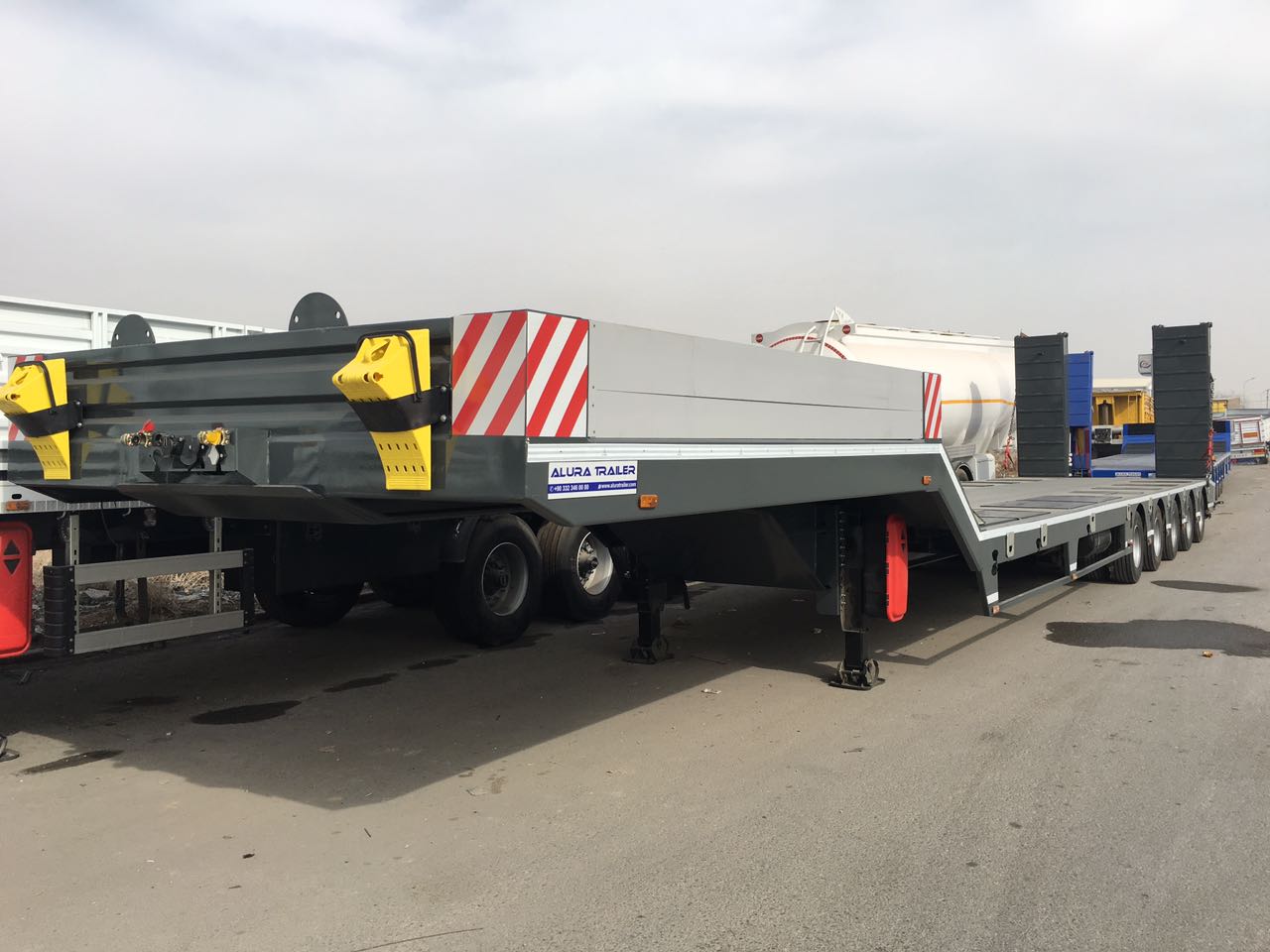
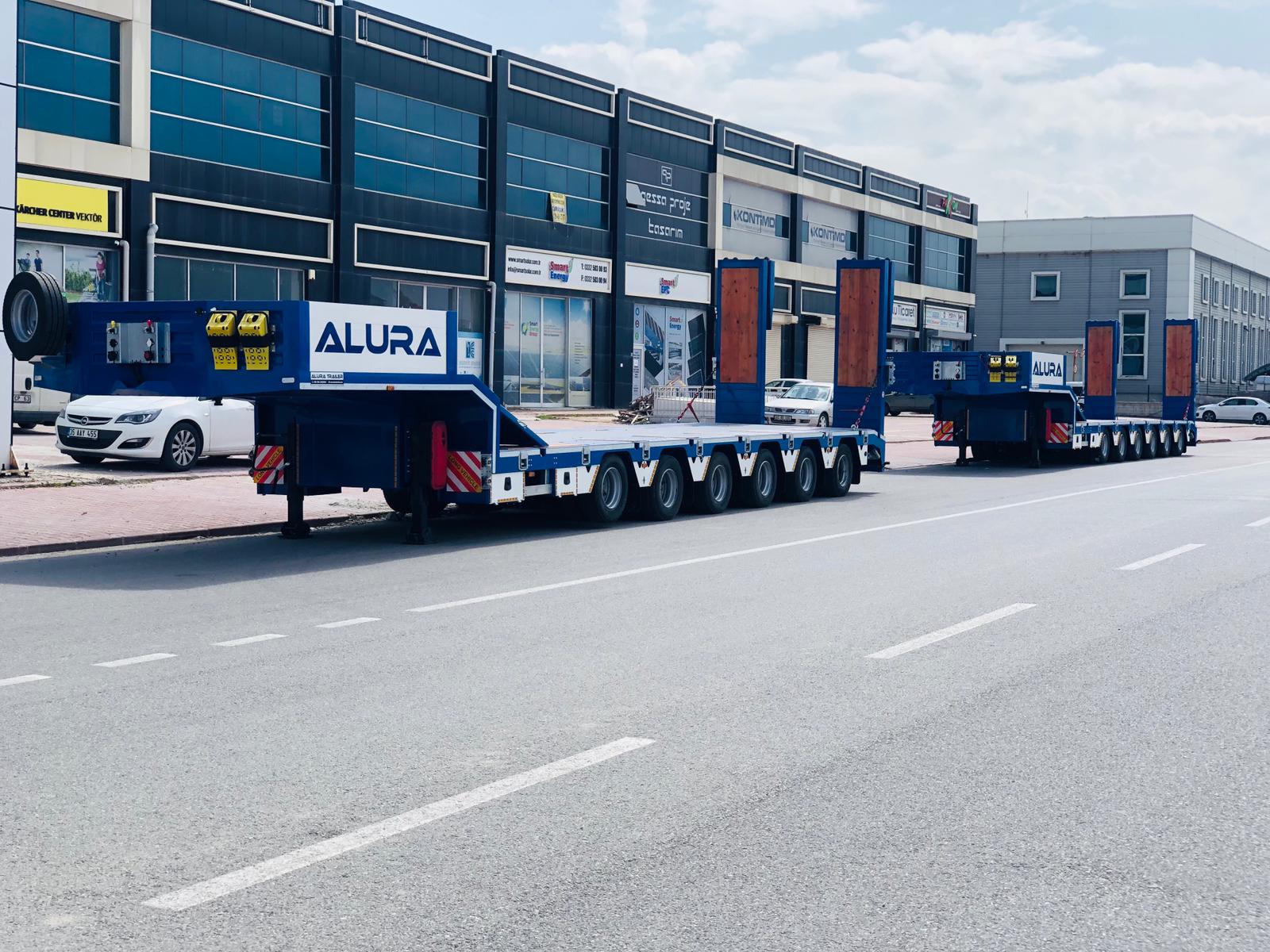
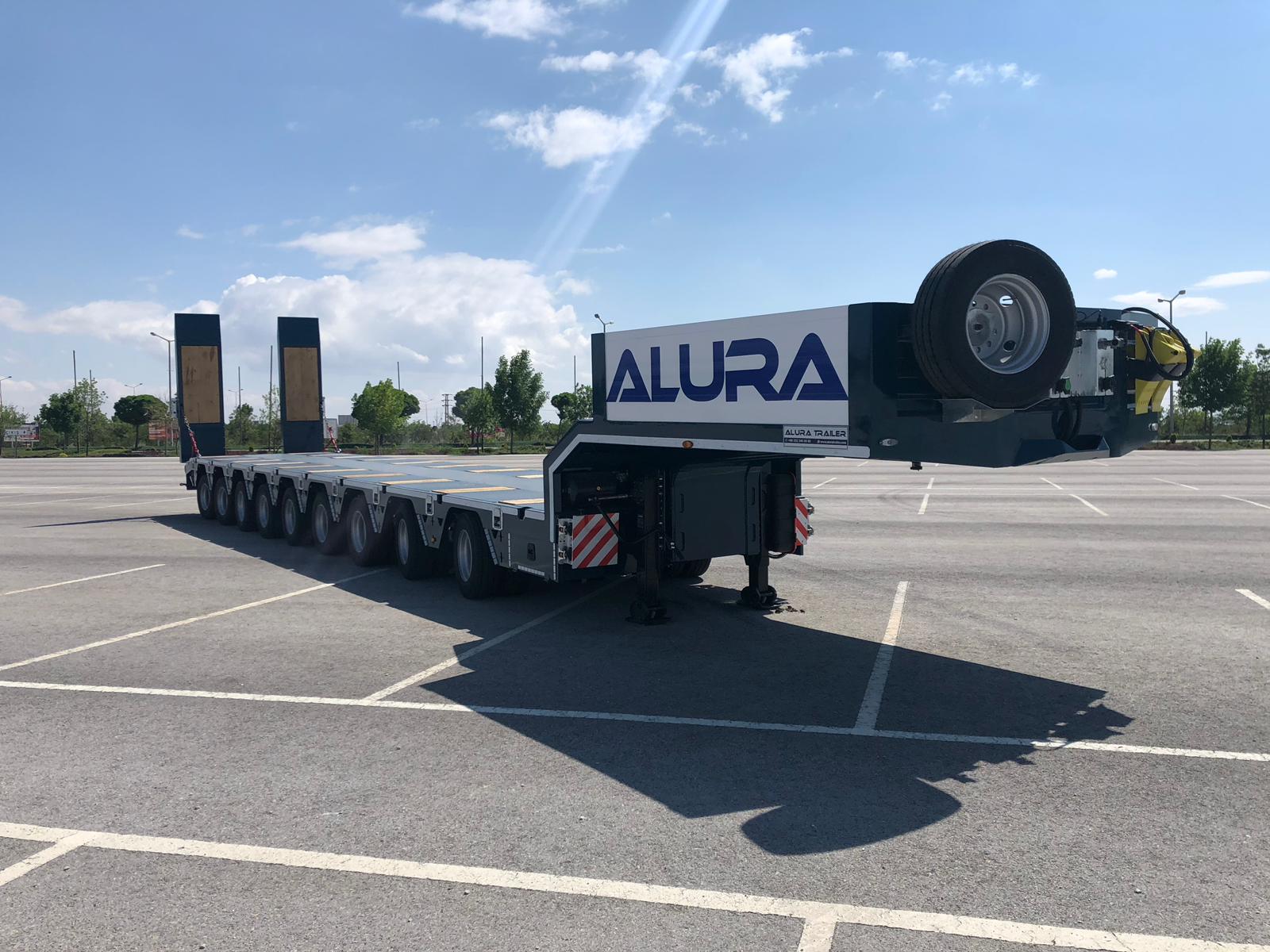
Explore Alura Trailer extendable and heavy-duty lowbed trailer configurations. Photographs may show different axle arrangements and options.
Extendable Lowbed Trailer Technical Drawing
The drawing below illustrates a 4 Axle Extendable Lowbed Trailer configuration. It is provided as a technical reference; final dimensions and extension geometry depend on the selected project.

Technical Documents and Catalogues
4 Axle Lowbed Technical Data Sheet
Technical reference document for a four-axle lowbed configuration.
Open Technical Data SheetAlura Trailer E-Catalogue
General product catalogue covering Alura Trailer semi-trailer configurations.
Open E-CatalogueVideo: Lowbed Trailers — Alura Trailer
💰 Price of This Configuration
Click to view the indicative starting price and contact our sales team.
Request Full Technical Offer for the Extendable Lowbed Trailer
Need a technical quotation including extension length, axle configuration, gooseneck design, ramp options, suspension and loading diagrams? Our engineering and sales team can prepare a technical-commercial proposal tailored to your cargo, operating country and route conditions.
Extendable Lowbed Trailers for Heavy Machinery & Project Cargo — Engineered for Real Industry Needs
Alura Trailer's Extendable Lowbed Trailers are developed for professional heavy-haul operators moving construction machinery, mining equipment, industrial components and special project cargo.
Construction & Mining Machinery
Designed for selected excavators, bulldozers, wheel loaders, graders, crushers and heavy-duty machinery.
Project & Industrial Cargo
Configurations for transformers, industrial modules, prefabricated units and long steel structures.
Flexible Ramp & Axle Options
Hydraulic or spring-assisted ramps, different ramp lengths, fixed or steering axles and optional lifting axles.
Export-Ready Design
Configurations can be evaluated for African, Middle Eastern and European markets, including suspension, braking and documentation.
Submit your configuration to explore technical data, drawings and component options.
Oversized Cargo Permits and International Transport Requirements
Transporting long or oversized cargo may require route surveys, special transport permits and operating restrictions that vary between countries.
The final trailer configuration must be assessed against the applicable requirements of the destination and operating countries.
How to Specify an Extendable Lowbed Trailer
Cargo Dimensions
Provide cargo length, width, height, weight and support positions.
Operating Conditions
Specify destination country, tractor configuration, transport route and maneuvering restrictions.
Trailer Configuration
Select preferred extension length, axles, steering, suspension, ramps and optional equipment.
Frequently Asked Questions About Extendable Lowbed Trailers
What is an extendable lowbed semi trailer?
An extendable lowbed semi trailer is a specialized transport vehicle with a telescopic chassis that can increase its effective loading length for oversized cargo.
What is the difference between a standard and extendable lowbed?
A standard lowbed has a fixed chassis length, while an extendable lowbed incorporates a telescopic structure that provides additional length for suitable cargo.
What is the typical length of an extendable lowbed?
The configurations listed on this page have approximate base lengths of 13.5–15 metres and extended lengths of 18–22 metres. Final dimensions depend on the project.
How does the telescopic extension system work?
The sliding chassis sections move relative to one another with hydraulic assistance. The extension is secured using the locking arrangement specified for the trailer.
Can the trailer be used at any extension length?
Permitted operating positions depend on the engineered extension mechanism, locking positions and approved load conditions. Intermediate positions should not be assumed permissible.
Does extending a lowbed increase its payload capacity?
No. Extension increases available length but does not automatically increase payload capacity. Structural loading and allowable cargo weight must be evaluated for each approved operating configuration.
Can an extendable lowbed transport wind turbine blades?
Extendable lowbeds can be considered for certain wind energy components. Blade transport often requires specialized blade trailers, supports or adapters depending on blade length and geometry.
Can it carry long steel beams and bridge components?
Yes, subject to cargo dimensions, support positions, trailer structural capacity, load securing and transport regulations.
Is hydraulic steering available?
Hydraulic steering can be evaluated as an option for suitable axle configurations and operational requirements.
Can the axle quantity be customized?
Axle quantity and spacing can be evaluated according to cargo requirements, vehicle design and destination-country regulations.
What happens to load distribution when the trailer is extended?
Extending the chassis changes the geometry of the load-bearing system. Cargo support points, bending moments, kingpin reaction and axle-group reactions must be checked for the operating configuration.
Is the extension mechanism hydraulic or mechanical?
The listed configuration features a hydraulically assisted telescopic extension system with mechanical locking positions. Final system details depend on the selected design.
Are extension locking pins required?
The telescopic structure requires an engineered locking arrangement. The exact pin, locking and safety design must be defined in the approved manufacturing documentation.
What is the approximate deck height?
The listed deck height is approximately 850–950 mm, depending on tyre size, suspension and chassis configuration.
Are detachable goosenecks available?
A detachable gooseneck may be evaluated as an optional design, subject to structural feasibility.
Is the trailer suitable for international oversized transport?
International transport depends on the approved vehicle configuration, applicable dimensional limits, axle loads, permits and route restrictions.
What information is needed for a quotation?
Provide cargo length, width, height, total weight, center of gravity if known, loading method, tractor configuration, operating country and preferred axle, suspension and steering options.
What is the starting price?
The indicative starting price displayed on this page is EUR 55,000. Final prices depend on specifications, optional equipment and delivery conditions.
Compare Other Lowbed Trailer Configurations
Explore fixed-length and multi-axle lowbed configurations for machinery transport and industrial project cargo.