4 Axle Lowbed Semi Trailer | Heavy Machinery Transport | Alura Trailer
Explore Alura Trailer's 4 axle lowbed semi trailer for heavy machinery, excavators and oversized project cargo. Compare axle configurations, loading systems, technical specifications and worldwide export options.

4 Axle Lowbed Trailer for Heavy Machinery & Project Cargo
Alura Trailer manufactures 4 Axle Lowbed Semi Trailers designed for the transportation of heavier construction machinery, large excavators, bulldozers, wheel loaders, crushers, drilling rigs and oversized industrial equipment requiring carefully engineered axle load distribution.
Built using ST52 and Strenx 700MC high-strength structural steel options, these lowbed trailers feature reinforced chassis structures intended to provide torsional rigidity and control deflection under the approved design loads.
With a low deck height, reinforced gooseneck, hydraulic or spring-assisted ramps and a four-axle configuration, this trailer is intended for heavy haulage fleets, infrastructure projects, mining operations and international project transport.
4 Axle Lowbed Semi Trailer — Key Specifications
These figures describe possible configurations rather than a single certified vehicle specification. Final dimensions, permitted loads and equipment are confirmed in the approved manufacturing drawings and technical offer.
Key Features & Advantages
- High-Strength Main Chassis: Reinforced ST52 / Strenx 700MC I-beam construction
- Axles: 4 × 12–13 ton nominal ratings, SAF / BPW / Osman Koc options
- Suspension: Mechanical leaf spring or air suspension
- Ramps: Hydraulic or spring-assisted ramps
- Gooseneck: Reinforced design with strengthened upper and lower plates
- Braking System: WABCO or Knorr-Bremse EBS / ABS options
- Side Extensions: Removable extensions subject to approved design
- Flooring: Hardwood, chequered plate or wear-resistant steel
- Tie-Down Points: Lashing rings and suitable machinery securing points
- Electrical System: 24V LED lighting with appropriate connections
Technical Specifications
- Main Chassis: High-strength ST52 / Strenx 700MC steel, reinforced welded I-beam design
- Platform Height: Approx. 850–950 mm, depending on final configuration
- Overall Length: Approx. 12,000–15,000 mm, configuration-dependent
- Axles: 4 × 12–13 ton nominal axle ratings
- Axle Brands: SAF, BPW or Osman Koc options
- Brakes: Drum or disc brakes, depending on axle selection
- Suspension: Mechanical leaf springs or air suspension
- Ramps: Hydraulic dual-cylinder or spring-assisted ramps
- Gooseneck: Reinforced neck with heavy-duty kingpin plate
- Steering: Fixed, self-tracking rear or optional hydraulic steering arrangements
- Tyres: 235/75 R17.5 or 245/70 R17.5 options
- Braking System: WABCO or Knorr-Bremse EBS / ABS options, with RSS where applicable
- Lighting: 24V LED lighting and appropriate electrical connections
- Floor: Hardwood and/or 4–6 mm chequered steel plate in selected areas
- Paint: Grit blasting, epoxy primer and protective topcoat
- Standard Equipment: Tool box, fire extinguisher cabinet, spare wheel carrier, wheel chocks, reflectors and rear protection
- Optional Equipment: Detachable gooseneck, steering axles, side extensions, special ramps, coil well, additional tool boxes and custom paint
All specifications can be customized according to country regulations, axle load limits, machinery dimensions and fleet operational requirements, subject to engineering review.
3 Axle vs 4 Axle Lowbed Semi Trailer
Choosing between a three-axle and four-axle lowbed involves more than comparing axle count. A fourth axle can provide an additional load-bearing position, but also changes the trailer's tare weight, axle spacing, maneuverability and applicable axle-group limits.
| Parameter | 3 Axle Lowbed | 4 Axle Lowbed |
|---|---|---|
| Number of Axles | 3 | 4 |
| Combined Nominal Rating with 12 t Axles | 36 tonnes | 48 tonnes |
| Combined Nominal Rating with 13 t Axles | 39 tonnes | 52 tonnes |
| Trailer Tare | Configuration-dependent | Typically affected by additional axle equipment |
| Turning Behavior | Depends on wheelbase and steering | May require steering or axle-lift solutions |
| Legal Axle Loads | Country-specific | Country-specific |
| Common Applications | Construction machinery and project cargo | Heavier machinery and specialized project cargo |
Nominal Axle Rating Comparison
The graph below compares arithmetic totals of nominal axle ratings. It is not a legal payload chart.
Combined Nominal Axle Ratings
Scale: 52 tonnes = 100%. Nominal component ratings are not equivalent to permitted axle-group loads.
Understanding Weight Distribution on a 4 Axle Lowbed
The supported trailer mass is distributed between the tractor's fifth wheel and the trailer axle group. The distribution is influenced by the cargo's center of gravity, loading position and trailer geometry.
Conceptual diagram only. Not a certified loading drawing or dimensional representation.
A forward cargo position may increase the reaction at the kingpin. Moving cargo rearward may increase the load carried by the axle group. The precise distribution must be calculated for the specific cargo and trailer geometry.
Fixed, Self-Tracking and Hydraulic Steering Axles
Fixed Axles
A conventional arrangement with mechanically fixed wheel orientation. Turning performance depends on wheelbase, axle spacing and operating conditions.
Self-Tracking Axles
Selected axles can follow the turning path under appropriate conditions, potentially reducing tire scrub and improving maneuverability.
Hydraulic Steering
A project-specific steering system may be evaluated for demanding turning geometry, site access and specialized transport requirements.
Hydraulic Loading Ramps and Approach Angle
Loading heavy machinery requires appropriate ramp strength, surface grip, approach geometry and clearance. A machine's track length, underbody clearance and attachment position can affect whether it can safely enter the trailer.
Hydraulic Ramps
- Powered raising and lowering
- Suitable for frequent loading operations
- Different ramp lengths and surfaces can be evaluated
- Require suitable hydraulic and locking systems
Spring-Assisted Ramps
- Mechanically assisted operation
- May offer simpler maintenance arrangements
- Require correct spring balance and locking design
- Must match the machine's loading requirements
Heavy Machinery and Industrial Cargo Applications
Construction Equipment
Large excavators, bulldozers, wheel loaders, graders and other heavy construction equipment.
Mining Operations
Heavy machinery and industrial equipment transported between mines, workshops and operational sites.
Infrastructure Projects
Equipment for roads, bridges, energy projects and industrial infrastructure development.
Project Cargo
Industrial modules, transformers, fabricated structures and specialized equipment requiring engineered load support.
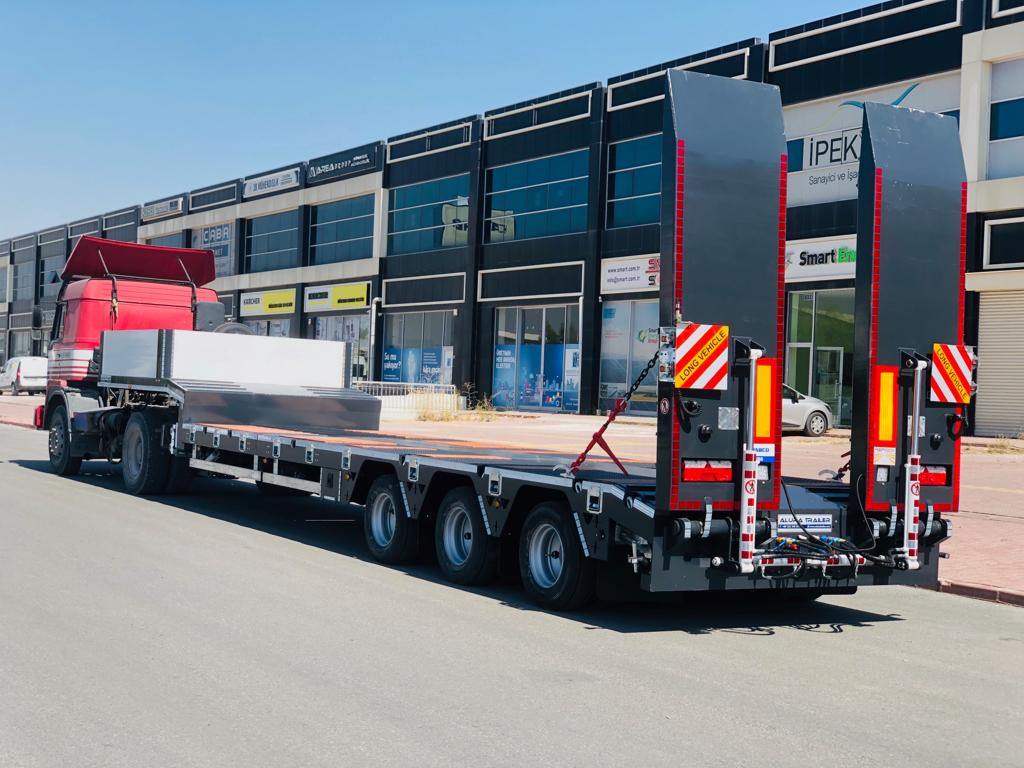
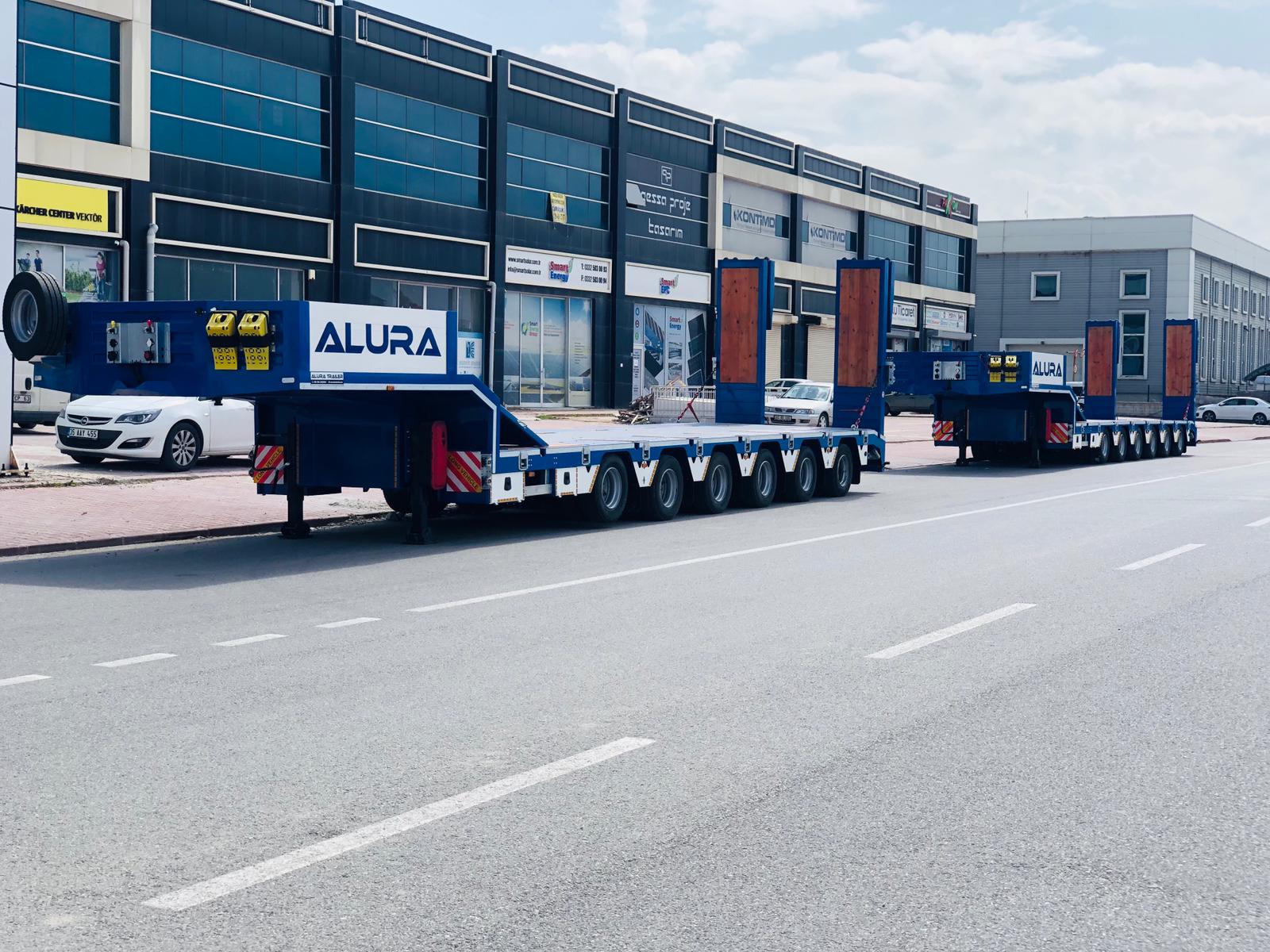
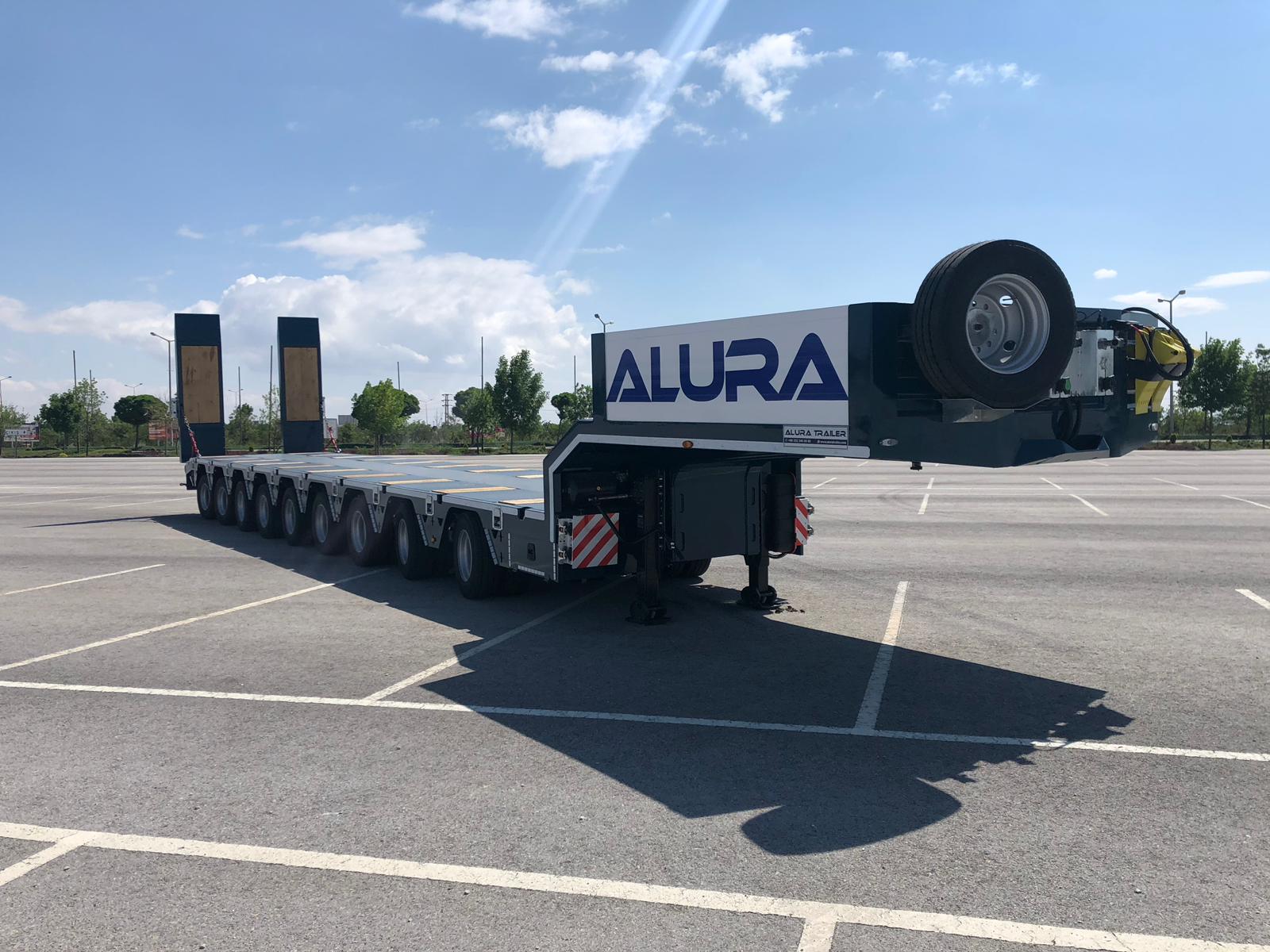
4 Axle Lowbed Trailer Photo Gallery
View Alura Trailer four-axle lowbed configurations, manufacturing details and trailer applications. Photographs may show different options and equipment.
4 Axle Lowbed Technical Drawing
The following drawing illustrates a four-axle lowbed configuration. Final dimensions and manufacturing details are confirmed in the approved project drawing.

Technical Documents and Catalogues
Alura Trailer 2025 Catalogue
Company product catalogue and available trailer solutions.
Open PDF DocumentVideo: Lowbed Trailers — Alura Trailer
💰 Price of This Configuration
Click to view the starting price and contact our sales team.
Request Full Technical Offer for the 4 Axle Lowbed Trailer
Need a detailed quotation including axle configuration, gooseneck design, ramp type, suspension options and loading drawings? Alura Trailer can prepare a technical-commercial proposal for your intended cargo and operating conditions.
Four Axle Lowbed Trailers for International Projects
Alura Trailer's four-axle lowbed solutions can be configured for heavy construction machinery, mining equipment, industrial components and special project cargo.
Construction & Mining
Lowbed transport solutions for demanding equipment and operating environments.
Industrial Project Cargo
Custom support arrangements and loading configurations for industrial machinery.
Axle & Ramp Options
Fixed, self-tracking or hydraulic steering options and selected loading systems.
International Supply
Technical configurations can be reviewed for European, African, Middle Eastern and other export markets.
Will Your Load Exceed Standard Transport Dimensions?
Use the Alura Trailer Height & Oversize Load Checker to estimate total transport height, cargo width status, payload class and possible oversize load risk.
- Calculate cargo height plus trailer deck height
- Check preliminary width and height risks
- Explore possible lowbed trailer recommendations
How Long Will Your Trailer Investment Take to Pay Back?
Use the Alura Trailer Cost & ROI Calculator to estimate trailer investment, monthly revenue, operating expenses, net profit and approximate payback period.
- Estimate monthly revenue and operating costs
- Calculate approximate investment payback
- Compare operating assumptions for trailer applications

Information Needed for a Four-Axle Lowbed Quotation
Cargo Details
Machine weight, dimensions, track width, attachments and center of gravity.
Tractor and Route
Tractor configuration, fifth-wheel rating, destination and road conditions.
Equipment Options
Axles, suspension, ramps, steering, extensions, paint and required documentation.
4 Axle Lowbed Trailer — Technical FAQ
What machinery can a 4 axle lowbed trailer transport?
Depending on the approved design and permitted loads, a 4 axle lowbed can be configured for large excavators, bulldozers, wheel loaders, crushers, drilling rigs, industrial machinery and oversized project cargo.
What is the axle capacity of a 4 axle lowbed trailer?
The listed configurations use four axles with nominal ratings of approximately 12 to 13 tonnes each. Combined nominal ratings are 48 to 52 tonnes, but legal axle-group loads and permissible payload may be lower.
What is the difference between a 3 axle and a 4 axle lowbed?
A four-axle arrangement adds another axle position and may improve load distribution for suitable heavy-haul applications. It also affects trailer tare weight, maneuverability, tire wear and legal axle-group limits.
Can a 4 axle lowbed carry a 60 tonne excavator?
This cannot be confirmed from axle count alone. The trailer's structural rating, tare weight, kingpin reaction, axle-group limits, tractor configuration, load position and route regulations must be assessed.
What is the platform height?
The approximate listed platform height range is 850 to 950 mm, depending on tires, suspension and design. The final loaded deck height must be confirmed from the approved drawing.
Which ramp options are available?
Hydraulic dual-cylinder and spring-assisted ramps are available as configuration options, subject to the required machine weight, loading geometry and engineering approval.
Is hydraulic steering available?
Hydraulic steering and self-tracking axle arrangements can be evaluated for projects requiring improved maneuverability.
Can the trailer be customized?
Yes. Platform dimensions, suspension, axle brands, ramps, steering, side extensions, flooring and paint can be configured subject to engineering feasibility.
What braking systems are available?
WABCO and Knorr-Bremse EBS or ABS options can be specified. Sensor and modulator arrangements must match the final approved brake design.
Is a four-axle lowbed legal on all roads?
No. Permitted axle-group loads, vehicle dimensions, gross combination weight and permit requirements differ by jurisdiction and route.
What information is required for a quotation?
The manufacturer should receive cargo dimensions, operating weight, center of gravity if available, tractor details, destination country, intended routes and preferred equipment.
What is the starting price of the 4 axle lowbed?
The indicative starting price displayed on this page is EUR 36,000. Final pricing depends on equipment, dimensions, manufacturing specification and delivery terms.
Other Lowbed Trailer Configurations
Different machinery weights, loading geometries and road requirements may call for alternative lowbed configurations.